How to Spot Tourist Trap Snack Stalls (and Where Locals Actually Eat)
The Tourist Trap Problem: Real and Widespread
Walk down Wangfujing Snack Street in Beijing and you will see scorpions, seahorses, and starfish on skewers -- exotic-looking items that exist for exactly one reason: Instagram. Walk three blocks to a local market and the same vendors sell lamb, chicken wings, and tofu skin. The scorpions are not Chinese street food culture. They are props for tourist photos, costing RMB 40-50 per skewer, roughly 4x what locals pay for lamb. Our editors put it bluntly: tourists come to Wangfujing and think they have experienced Chinese street food. They have experienced a theme park version.
The Five Telltale Signs
Sign 1: The English Menu Test
The more languages on the menu, the higher the tourist markup. A stall with a laminated menu in English, Japanese, Korean, and Thai is running a tourism business, not a food business. We have documented markups of 30-50% on English versions versus Chinese versions. What to look for instead: no printed menu at all -- just a chalkboard or handwritten sign in Chinese.
Sign 2: The Scorpion Principle
Any food sold primarily for its shock value is a tourist trap. Real Chinese street food does not look shocking when photographed. It looks like food. A bowl of mala tang, a freshly made jianbing -- these do not generate viral videos. They just taste good. The scorpions, seahorses, and starfish on Wangfujing exist for the camera, not the palate.
Sign 3: The Turnover Test
Our field test: stand near a stall for 3 minutes and count customers. Fewer than 3 visitors in that window means the food is likely sitting. More than 6 visitors means you have found something real. High turnover means fresh food. A stall with the same tray of pre-made dumplings sitting out for 20 minutes with no buyers is sending a clear message.
Sign 4: The Selfie Stick Density Test
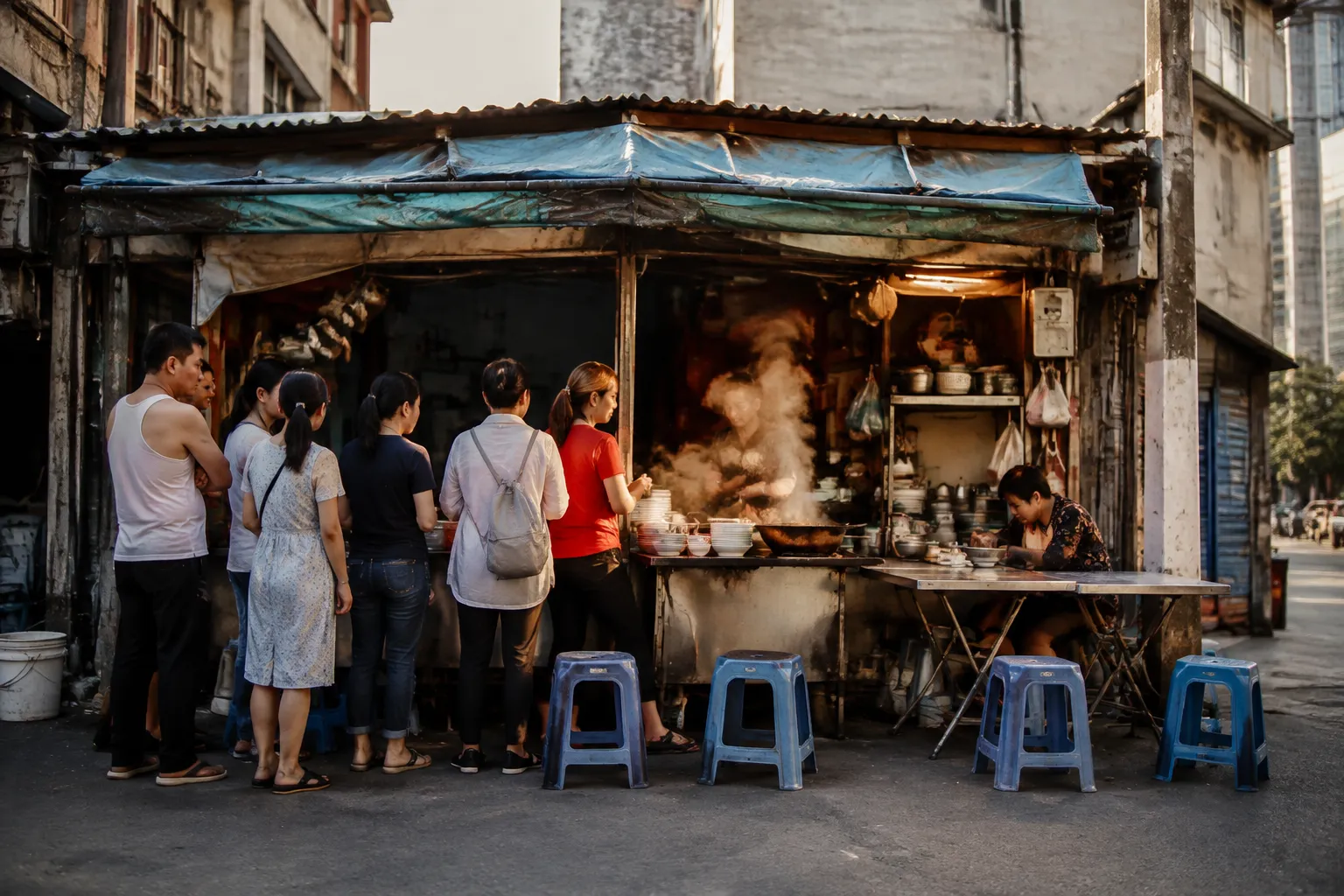
Look at the queue. What are people doing with their phones? If most customers are photographing food before eating, you are in a tourist zone. If phones are in pockets and people are just eating, you have found a local spot. In Chengdu, we observed: tourist-facing stalls on Jinli main drag had roughly 70% of customers photographing food. At Jianshe Road Night Market, that number drops below 15%.
Sign 5: The Condiment Test
Tourist stalls serve food pre-seasoned with no customization. Real local stalls provide chili oil, vinegar, and pickled vegetables for customers to adjust themselves. If you see a jar of chili oil and black vinegar on the counter that customers actively use, you are in the right place. The absence of condiments is itself a signal.
City-by-City: What to Skip, Where to Go Instead
Beijing
Skip: Wangfujing insect section (exists for photos, not food). Go instead: Guijie (Ghost Street, gui jie) in Dongcheng District -- over 100 restaurants specializing in spicy crawfish and Sichuan dishes, open until 4 AM. Also: breakfast stalls near universities in Haidian District -- jianbing at RMB 6-8 vs RMB 15-20 on Wangfujing.
Chengdu
Skip: Jinli Ancient Street main drag (photogenic but priced 50-100% above local standards). Go instead: Jianshe Road Night Market in Chenghua District. Mala tang costs RMB 15-25 vs RMB 35-50 at Jinli. Chuan chuan is RMB 0.5-1 per stick vs RMB 2-3. Editor's pick: the hongyou chaoshou cart with a red awning near the university end -- RMB 15 for 10 wontons, same recipe since 2019.
Xi'an
Skip: First 200 meters of Muslim Quarter main street (flashy stalls with English signs). Go instead: Walk 3-4 blocks deeper to Dapiyuan Street and Sajinqiao. Roujiamo at Fan Ji on Zhubashi Street (operating since 1925) and liangpi at Wei Jia Liangpi on Dapiyuan Street are the real institutions. The local litmus test: if you see Xi'an locals eating liangpi at a stall while standing up on a weekday lunch hour, you have found an authentic spot.
Shanghai
Skip: Yuyuan Garden food court (beautiful architecture, mediocre food at premium prices -- xiaolongbao at RMB 45-60 vs RMB 18-30 at local shops). Go instead: Yunnan Road Food Street -- Yang Fry Dumplings, Jia Jia Tang Bao, A Cheng Scallion Pancakes. Editor's local tip: the best shengjian bao we have had in Shanghai was at a nameless stall near a residential complex in Hongkou District. No sign, no English, just a line of retirees at 7 AM.
Guangzhou
Skip: Mall dim sum chains (factory-made, frozen and reheated). Go instead: Panxi Restaurant on Longjin West Road or Tao Tao Ju on Shangxiajiu Street -- both operating since before WWII, making fresh dim sum to order. The har gow and cheong fun at Panxi are the standard by which Cantonese dim sum should be measured.
The Price Gap: Tourist vs. Local (Real Numbers, July 2026)
| Snack | Tourist Price | Local Price | Markup |
|---|---|---|---|
| Jianbing (Beijing) | RMB 15-25 | RMB 6-10 | ~150% |
| Chuan Chuan (Chengdu) | RMB 2-3/stick | RMB 0.5-1/stick | ~200% |
| Lamb Skewers (Xi'an) | RMB 15-20 | RMB 5-8 | ~200% |
| Xiaolongbao (Shanghai) | RMB 45-60 | RMB 18-30 | ~150% |
| Tanghulu (Beijing) | RMB 15-20 | RMB 5-8 | ~200% |
FAQ: Avoiding Tourist Traps
What if I cannot read Chinese? How do I find local stalls?
The methods in this guide do not require reading Chinese. Follow the queue of locals. Check for turnover. Watch for charcoal vs gas. Notice condiments on the counter. None of these require language skills. You can also use the phone screen method from our ordering guide.
Are all famous snack streets tourist traps?
No. Some famous streets (Xi'an Muslim Quarter, Shanghai Yunnan Road) have both tourist-oriented stalls and genuine institutions. The key is knowing which specific stalls on a famous street are the real ones. In this guide, we name specific stalls -- those are the ones worth seeking out.
Is tourist stall food unsafe?
Not usually unsafe -- just overpriced and mediocre. Chinese food safety standards apply to tourist stalls and local stalls equally. The issue is value and authenticity, not hygiene. You are paying more for less interesting food.
ChineseSnacks Editorial Team
ChineseSnacks is an independent editorial team publishing practical guides to eating street food in China. Every guide is built from verifiable sources: price ranges checked against current market data and online retail channels, snack recommendations cross-referenced with local community feedback (including Reddit's r/beijing and r/chinesefood), brand and product details sourced from official channels, and locations verified against maps and traveler reports. Content is reviewed quarterly, and reported errors are corrected within days.