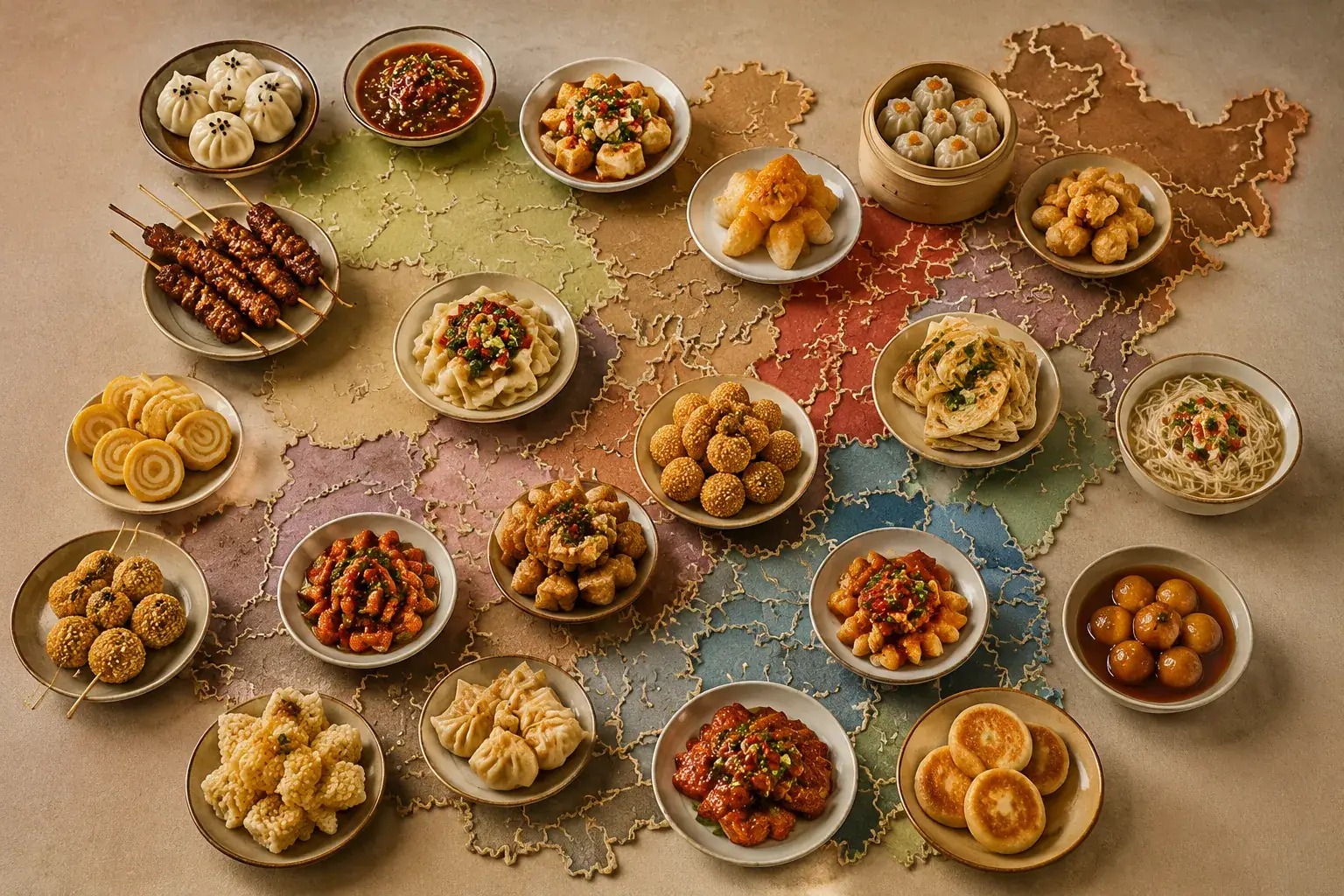
Sweet, Salty, Spicy, Numbing: A Regional Guide to Chinese Snack Flavors
A Country of Culinary Fault Lines
China snack flavors are not random variations -- they are the edible expression of 3,000 years of geography, climate, trade routes, and imperial history. The chili that defines Sichuan cuisine did not arrive in China until the 16th century, carried by Portuguese traders from the Americas. Before that, Sichuan food was flavored primarily with Sichuan pepper and fermented bean pastes. The chili arrival created an entirely new cuisine within a century -- a reminder that Chinese food culture is dynamic, not frozen in time. Understanding these flavor patterns makes every snack more interesting, because you can taste the history along with the food.
Northern China: Wheat, Fermentation, and Winter Warmth
Cold winters and wheat-growing plains produced a snack culture built around fermented bean pastes, hearty breads, and slow-cooked meats. The jianbing is the perfect northern snack: wheat-based, egg-enriched, with fermented bean paste complexity and fresh scallions. Zhajiang mian uses fermented soybean paste (huang jiang) as its backbone -- the Chinese equivalent of miso, deeply savory and complex. Tanghulu, the only sweet snack that truly defines the north, provides its own contrast: hard sugar shell meeting intensely sour hawthorn berry. Northern snacks rarely feature fresh herbs (cilantro and scallions are the exceptions), raw vegetables, or bright acidic notes. Rice-based snacks are almost nonexistent. The flavors are direct and unlayered -- what a Sichuan chef would call honest with a hint of condescension.
Sichuan: The Mala Kingdom
Mala (ma la) is two sensations, not one:
- Ma (ma) -- numbing: The electric, tingling sensation created by huajiao (Sichuan peppercorns). Hydroxy-alpha-sanshool, the active compound, stimulates touch receptors at a frequency of 50 Hz -- the same as a light vibration. Your tongue is not burning; it is vibrating. This is unique to Sichuan pepper and has no analogue in any other world cuisine.
- La (la) -- hot: The burning from chili peppers, which arrived from the Americas in the 16th century. Before chili peppers, Sichuan food used only ma (numbing) and heat from ginger and native spices.
The genius of Sichuan cooking is not just adding both -- it is balancing them against cooling elements. Bingfen after hot pot is not an afterthought; it is the planned counterweight. Baocai served alongside mapo tofu is not a free side dish -- it is the palate reset between bites of intense heat.
Chengdu vs. Chongqing: A Tale of Two Malas
Chengdu mala: Complex, layered, fragrant. The chili oil is the star -- dried chilies slowly infused in oil with star anise, cinnamon, and cardamom. Dan dan mian balances chili oil, sesame paste, and preserved vegetables. Hongyou chaoshou is a study in fragrant heat. Chongqing mala: Aggressive, oily, immediate. Xiaomian hits you on the first bite. The chili oil is darker and more intensely roasted. Chongqing hot pot uses roughly 50% more chili and Sichuan pepper than Chengdu version. Our editors summarize: Chengdu food asks you to slow down and notice the layers. Chongqing food dares you to finish the bowl.
Northwest / Xi'an: The Silk Road on a Plate
Xi'an sits at the eastern end of the Silk Road. For 2,000 years, traders from Persia, Central Asia, and the Middle East passed through, bringing spices, cooking techniques, and religious dietary laws that permanently reshaped local cuisine. The flavor trinity: cumin (toasted whole, ground coarse -- smokier and more aromatic than Indian or Mexican cumin, the dominant note on every lamb skewer), lamb (the protein of the steppes, simmered for hours in yangrou paomo), and wheat in all forms -- flatbread (mo), hand-pulled noodles, and translucent liangpi sheets. The roujiamo is the ultimate fusion: Central Asian flatbread meets Chinese braising technique, with cumin bridging both worlds.
Eastern China / Shanghai: Sweet, Subtle, Precise
Shanghai snacks are defined by natural sweetness and textural contrast. The sweetness comes from fresh pork, dark soy sauce, and Shaoxing rice wine -- not sugar. A shengjian bao achieves satisfaction through contrast: crispy bottom, soft top, hot broth, savory pork. Each element plays against the others. Shanghai does not do spicy -- the relationship with chili is almost nonexistent. A bowl of xiaolongbao succeeds or fails on whether you can taste the pork through the broth. Scallion pancakes demonstrate the philosophy perfectly: three ingredients (dough, scallions, lard) turned into 30+ paper-thin layers through technique alone.
Southern China / Guangzhou: Dim Sum and Ingredient Worship
If Sichuan cooking is about transformation and Shanghai is about precision, Cantonese cooking is about not ruining the ingredient. The highest compliment is that a dish tastes fresh and sweet (qing tian) -- the ingredient natural flavor unmasked. Har gow succeeds when the shrimp tastes like shrimp and the translucent wrapper provides texture without flavor. Cheong fun with sweet soy is a whisper, not a shout. Cantonese culture obsesses over texture: the QQ (springy, bouncy) bite of wonton noodles, the wobble of a fresh egg tart custard. The test of a Cantonese chef has always been their har gow -- if the pleats are not exactly right and the wrapper is not translucent, nothing else on the cart will be either.
How the Regions Talk to Each Other
Chinese snack culture is not frozen in regional silos. Migrant communities carry food traditions across the country. A Beijing resident in 2026 has access to better Sichuan food than a Chengdu resident did in 1980. A Shanghai office worker can get authentic Xi'an liangpi at lunch without leaving the city. The flavors are spreading and evolving -- which makes understanding the regional roots even more valuable, because it lets you taste the history in every bite, whether you are eating it 2,000 kilometers from its origin or right at the source.
FAQ: Understanding Chinese Snack Flavors
Why is Sichuan food numbing, not just spicy?
The numbing (ma) comes from hydroxy-alpha-sanshool in Sichuan peppercorns, which stimulates touch receptors at 50 Hz -- like a light vibration. This sensation is unique to Sichuan pepper. The numbing actually enhances the perception of other flavors by temporarily altering nerve sensitivity on the tongue.
What is the difference between Hunan hot and Sichuan hot?
Hunan (Xiang) cuisine is purely hot (la) -- aggressive chili heat without numbing. Sichuan adds numbing (ma), creating two-dimensional heat. Hunan is described as dry heat and Sichuan as wet heat due to heavy chili oil use in Sichuan cooking.
Are there spicy snacks in northern China?
Very few. Northern China indigenous cuisine is not spicy. The spicy food you find in Beijing (mala tang, Sichuan restaurants) is imported from the southwest through migration. Beijing own snack tradition -- jianbing, zhajiang mian, lamb skewers -- uses zero chili pepper in its traditional form.
ChineseSnacks Editorial Team
ChineseSnacks is an independent editorial team publishing practical guides to eating street food in China. Every guide is built from verifiable sources: price ranges checked against current market data and online retail channels, snack recommendations cross-referenced with local community feedback (including Reddit's r/beijing and r/chinesefood), brand and product details sourced from official channels, and locations verified against maps and traveler reports. Content is reviewed quarterly, and reported errors are corrected within days.